The Best Artificial Grass for Sacramento Summers
Turf material, color, and infill all affect how hot the surface feels, with darker colors, commodity plastics, and rubber infill running hotter. Probing for details like cooling technologies, reflective pigments, lighter colors, and advanced fiber designs can help homeowners choose cooler-performing options, and AGL Grass has them.
Jerry
Owner, AGL Grass North
Key Takeaways
Artificial grass gets hotter than natural grass in Sacramento, CA, under full summer sun, and can reach temperatures over 140°F on peak afternoons. It’s crucial to test the surface before walking barefoot or letting kids and pets play on it. Shade and a quick rinse with the garden hose can quickly drop the temperature and make the turf more comfortable.
Sacramento’s long, dry, high-UV summers send many outdoor surfaces into a heat “danger zone,” making heat-resistant turf an intelligent choice for safety and comfort. When making selections, opting for products engineered for hot climates ensures backyards, play areas, and pet zones remain accessible and enjoyable longer each day.
Turf material, color, and infill all affect how hot the surface feels, with darker colors, commodity plastics, and rubber infill running hotter. Probing for details like cooling technologies, reflective pigments, lighter colors, and advanced fiber designs can help homeowners choose cooler-performing options, and AGL Grass has them.
Steaming-hot turf burns feet and paws, keeping families from enjoying their yards during the heart of Sacramento’s summer. Easy measures like testing the surface with your hand, offering shaded areas, and scheduling playtime for mornings or evenings minimize this risk.
No-infill turf systems like those offered by AGL Grass North typically remain cooler because they eliminate heat-retaining rubber and sand, allowing more airflow. These designs cool down faster after sunset or with a quick rinse, a boon for hectic households seeking low-maintenance, pet- and kid-friendly lawns.
If you factor in your yard’s microclimate by looking at sun, shade, airflow, and nearby reflective surfaces, you can place turf where it will stay coolest. When you combine cool turf products with trees, pergolas, shade sails, and solid base preparation, you create a more comfortable outdoor space during Sacramento’s hottest months.
The Short Answer
Yes, artificial grass does get hot in the Sacramento, CA summer, frequently significantly hotter than natural grass in direct sun.
With July highs often in the 95-100°F range, turf temperatures can climb quickly in south-facing yards, pool decks, and rooftop areas.
Shade, infill type, and turf color all affect how hot it feels on bare feet or pets’ feet.
The following segments deconstruct what to expect and provide easy steps to keep turf cooler.
How Hot Does Turf Get?
Sacramento’s artificial turf does indeed run hotter than grass, and at its summer hottest, it is too hot for bare skin without some forethought and cooling.
Summer Surface Temperature Comparison
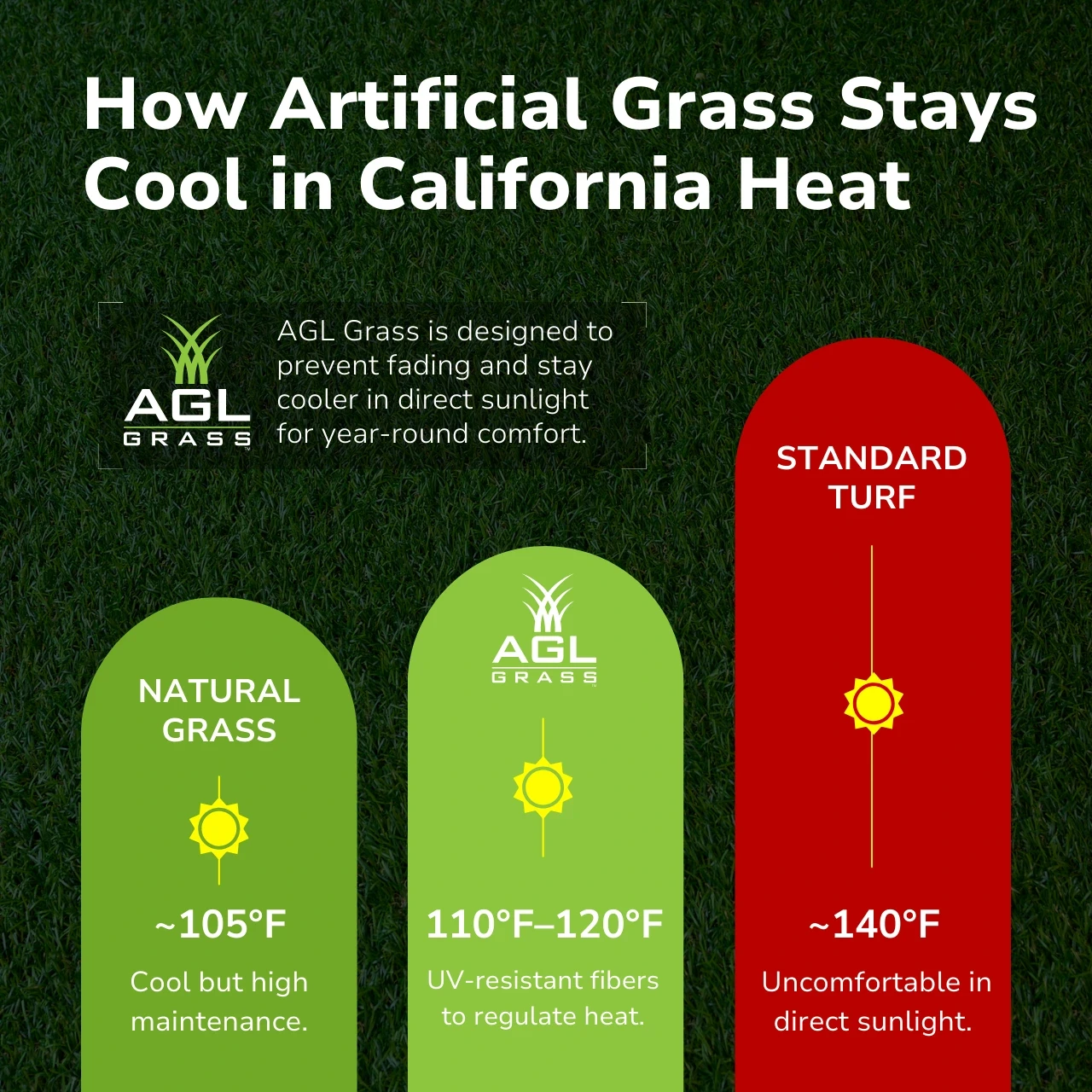
Under the same full-sun conditions, no-infill AGL Grass runs roughly 20 to 30 degrees cooler than conventional infilled turf.
Turf System | Approx. Surface Temp (°F) |
|---|---|
Standard turf | 140°F |
AGL Grass (no-infill) | 110–120°F |
1. The Sacramento Sun
Sacramento is located in a hot, dry inland valley, which means our summers sometimes feature extended runs of 95 to 105-degree days, low humidity, and minimal cloud cover. That combination means harsh UV and countless hours of full sun on any treeless yard without pergolas or shade structures.
On a 100-degree day, natural grass typically hovers around 85 to 90 degrees, while surrounding turf can reach 140 to 150 degrees or higher in direct sunlight. Asphalt and dark concrete can run even hotter, often in excess of 160 degrees Fahrenheit, but turf still shifts into a “danger zone” where kids, pets, and seniors can scald feet or hands.
Here in the valley, where heat waves sometimes feel like blowing desert sands, turf frequently acts more like a scorching playground surface than a refreshing lawn. It’s these local patterns that make the Sacramento sun such a crucial design element. High UV and prolonged sun exposure stress any synthetic surface, so selecting cooler turf systems and engineering shade aren’t just for comfort. They’re for safety.
2. Material Matters
Most residential turf is made of plastic fibers such as polyethylene, polypropylene, or occasionally nylon. Live blades of grass retain water and cool via evaporation, while these plastics absorb sunlight and trap heat. As a result, artificial turf can heat up quickly, sometimes climbing to well over 150°F on exposed, dark-colored fields.
Not all fibers act similarly. More advanced blades with reflective pigments and lighter greens bounce more UV light away, helping keep surfaces several degrees cooler than basic, darker turf. A few are sculpted to enable more airflow between fibers, helping heat escape rather than accumulate at the surface.
For Sacramento’s climate, items constructed with cooling technology and lighter, UV-stable plastics tend to be a better fit than bargain turf. Most of these solutions, combined with one or two other cooling measures, help maintain turf in the 120 to 140 degrees Fahrenheit range rather than pushing toward the extreme 160 to 180 degrees Fahrenheit spikes sometimes witnessed on ancient fields in desert locales.
3. The Infill Factor
In most turf systems, the space between blades is filled with rubber crumb, sand, or blends. These infills can trap heat, with dark rubber in particular working like a car tire parked in the sun, raising surface temperatures significantly.
Color and material both count. Dark rubber infill soaks up a ton of solar energy and can really nudge turf toward the upper end of the normal 120 to 180 degrees Fahrenheit scale on a scorchingly hot day. In contrast, modern turf options, like cooling infill products, attempt to fight back by holding onto moisture and releasing it slowly, lowering temperatures by as much as 50°F during peak sun.
Cooling infill products attempt to fight back by holding onto moisture and releasing it slowly, lowering temperatures by as much as 50°F during peak sun. No-infill options, such as AGL Grass North, eliminate that heat-holding layer, which can make a noticeable difference in residential yards.
Below is a simple comparison example under the same 100°F full-sun conditions in Sacramento, highlighting the effectiveness of artificial turf in maintaining a comfortable lawn.
Turf System | Approx. Surface Temp |
|---|---|
Dark turf + black rubber infill | 150–160°F |
Light turf + cooling infill | 110–130°F |
No‑infill turf (e.g., AGL Grass North) | 110–120°F |
4. Surface Reality
In numerous experiments, synthetic grass has been found to get much hotter than traditional grass. Turf under the Sacramento sun routinely reaches 140 to 150 degrees Fahrenheit and beyond, while an adjacent real grass lawn hovers around 88 degrees Fahrenheit. That difference is great enough to shift turf into a burn-risk zone, particularly for kids’ bare feet or dogs’ paws on a long, sunny afternoon.
Heat buildup occurs quickly with synthetic lawns. As the plastic blades soak up sunlight, the surface temperature can soar from warm to well over 150°F in a matter of moments once the sun is fully exposed. The great news is that it can cool off just as fast as you add shade or water.
Shaded synthetic grass areas remain up to 30% cooler than the same product in full sun, and a light spray during the hottest hours can temporarily cool the surface by up to 50°F. On a 100° day, that can mean dropping from 150° to 100° immediately after rinsing, which is usually enough time to soothe the lawn back into comfortable play.
As it varies hour to hour, it is good to spot-check the surface with your hand or a basic IR thermometer throughout July and August and adapt use, shade, or watering accordingly.
Why Heat Is a Concern
With Sacramento’s long, dry, super-UV summer, heat is not a small issue for artificial grass. It impacts comfort, safety, and how much you can really enjoy your yard. Turf that heats to 140 to 150 degrees Fahrenheit and beyond transforms a beautiful lawn into a surface you dodge, not relish.
Overheated turf can cause:
Skin burns and blisters on bare feet or hands
Pet paw burns, cracking, or raw pads
Heat stress for kids, older adults, and pets
Falls or injuries may occur if people run off the hot surface.
Damage to certain turf products occurs more quickly in intense heat.
Since common turf materials such as nylon, polyethylene, and polypropylene absorb heat rather than reflect it, surface temperatures on synthetic turf can reach around 54°F hotter than adjacent natural grass, in a Sacramento heat wave, which can push turf well beyond 150°F, right up there with dark asphalt.
Cheap rubber infill and poor UV protection exacerbate the problem by trapping heat and degrading in the sun, respectively, potentially causing the surface to absorb even more heat over time. For areas that experience extended periods like this, such as parts of Arizona, Nevada, or Texas, selecting turf designed for hot climates isn’t a luxury; it’s what makes a space usable.
Barefoot Burns
Bare feet on hot synthetic grass can scorch quickly on a Sacramento summer afternoon, particularly between late morning and early evening when the sun is at its peak, and the specialized fibers absorb the heat. Kids dashing out from a shady patio onto open artificial lawns will sense a swift sting within seconds, which can convert into actual burns or blisters when the surface temperature exceeds 130 to 140 degrees Fahrenheit.
Have families and guests get into the habit of checking the turf first. A quick touch test with your palm or the back of your fingers says a great deal. If you can’t hold it down for a few seconds, it’s not safe for bare feet or kids sitting and crawling on it.
Some owners rely on easy rules, such as ‘no barefoot play from 11 AM to 4 PM in July and August’ unless the artificial turf is cooled. No heading, just plain cooling steps help. Shade sails, trees, or umbrellas can effectively reduce temperatures in the hottest areas.
A quick shot from the hose can lower the surface temperature by up to 50 degrees for a short time, often the difference between painful and comfortable. Synthetic grass products, such as AGL Grass with no-infill, stay cooler than systems that use dark crumb infill, providing a safer surface for barefoot play, pool edges, and playgrounds.
Pet Paw Safety
A dog’s and a cat’s paws are extremely heat sensitive, and hot artificial turf can burn them just as fast as bare human skin. When those same fibers reach 140 to 150 degrees Fahrenheit on a sunny Sacramento afternoon, Fido and Fluffy are limping or refusing to walk after just a few moments of exposure.
A good habit is to do a simple hand check on the turf before releasing pets loose. If your palm is burning on a hot stove, your dog’s feet are burning too, and frequently, sooner.
Cooler turf alternatives, such as AGL Grass systems crafted without heat-trapping infill, provide enhanced pet-friendly yards, dog runs, and side yards. They cool off more quickly in the shade or with a quick hose rinse and do not retain as much heat into the evening.
Shade structures, covered runs, and access to cooler surfaces, such as shaded concrete or a natural mulch area, provide options for pets. These little design decisions minimize the risk of paw burns and reduce the possibility that elevated turf temperatures will curtail their outdoor time.
Usable Space
When turf bakes, your yard may appear verdant yet lie abandoned for hours daily. In extreme heat, many owners find they avoid their lawn from late morning to late afternoon, so a large portion of the property is effectively out of bounds.
Cooler-running kids’ turf keeps more of the day usable for kids’ play, relaxation, or small gatherings, even in July and August. That can measure the difference between a lawn you mostly stare at and one you actually use.
Design decisions count a lot in this regard. Combining synthetic turf with other shade elements, such as trees, pergolas, shade sails, or covered patios, provides humans and animals with cooler “landing spots” and helps disrupt the hottest areas.
Zones that receive the harshest midday sun, such as south or west-facing strips, respond best to shade or cooler turf options. AGL Grass North provides turf lines engineered to withstand blazing sun and intense heat yet remain cooler underfoot. The turf surface stays within a functional range year-round, rather than feeling like a hot parking lot during peak summer.
The No-Infill Advantage
It’s why AGL Grass North’s no-infill synthetic grass is designed for hot, dry Sacramento summers, when backyards and side yards bake in the sun for hours on end. Eliminating sand or crumb rubber infill, this turf remains significantly cooler, drains better, requires less maintenance, and withstands everyday wear and tear from kids and pets. With artificial turf options like this, homeowners can enjoy a vibrant green lawn year-round.
Conventional infill acts as a heat sink, with those little rubber or sand granules absorbing and retaining solar heat, which drives up surface temperatures. A no-infill system eliminates excess mass, providing more open volume for air and water to circulate, allowing the synthetic lawn to cool down more quickly during and after the peak afternoon sun.
Heat is only one of the reasons infill is unnecessary. The others are covered in the myths around no-infill turf.
For families, that shift shows up in simple ways: dogs are more willing to walk across the lawn at 3 PM, parents feel safer about kids playing barefoot, and surfaces recover faster after a quick hose-down. A lot of people enjoy no-infill turf because it’s smoother and more pleasant to walk or sit on, since there aren’t any loose granules sliding around.
Key advantages of no-infill artificial turf from AGL Grass North include lower maintenance and a cleaner, more organic appearance that complements local landscaping aesthetics. While no-infill can be more expensive upfront, many Sacramento homeowners find long-term value in a more comfortable summer and a beautiful yard. Not to mention the more eco-friendly alternative to artificial turf. Now that’s a mouthful!
Cooler surface temperatures in direct Sacramento sun
Improved airflow and drainage reduce heat accumulation and puddling.
Gentler and more uniform underfoot for children, animals, and seniors.
Less regular maintenance because there isn’t any infill to refresh or wash.
Cleaner look, with no random bits of rubber or sand on patios or inside the house.
Less worry about nonrenewable infill materials
In a climate where drought is common, investing in synthetic grass can be a wise choice for those looking to maintain a lush green lawn without the hassle of regular watering and mowing.
How It Works
AGL Grass North’s no-infill turf features a denser, technologically superior fiber matrix that holds each blade erect without the ballast of rubber or sand, making it one of the best synthetic grass products available. The yarn shape, stitch rate, and pile height are chosen to ensure that the grass blades support one another, creating a thick patch of natural fescue. This design yields a stable, soft feel even without loose fill distributed between fibers, contributing to a comfortable lawn experience.
Without infill compacted into the turf’s base, less material is exposed to Sacramento’s intense summer sun and high temperatures. This openness allows heat to dissipate rather than being trapped near the surface. When you spray the surface with a hose, the turf can shed heat and dry faster due to improved airflow and water penetration. The turf can shed heat and dry faster due to improved air and water flow with less resistance.
The backing is a big deal. AGL Grass employs a proprietary backing system that locks fibers in place and provides support to the turf, so it does not depend on infill to remain flat or resist wrinkling. This backing cooperates with the drainage holes to wick water down and out and away, helping prevent moist-pile odors without the Sacramento you see in pet rooms.
Together, this innovative fiber-and-backing construction results in a firm surface with reduced heat retention. In hot climates like Sacramento, this translates into consistently cooler performance on patios, pool decks, and small courtyards, making it an excellent choice for warm-weather landscaping.
Air Circulation
No-infill grass systems provide much more open space between and below the fibers, leading to enhanced airflow throughout the entire turf layer. Rather than heat collecting in a compacted rainfall of plastic blades and infill granules, air can flow in from the edges and underneath, dissipating heat all day.
As the air circulates more freely, the surface cools more naturally, just as a well-ventilated wood deck feels cooler than a solid concrete slab. Even when the sun is beating down, that steady flitting of air helps keep the turf closer to ambient air temperature, which is important in compact Sacramento lots, where reflected heat from stucco or pavers can raise temperatures.
The increased airflow helps combat moisture. Water from irrigation overspray, pool, or pet splashes has more direct avenues to flow down rather than ponding at the base of the blades. That helps minimize odors and bacteria, which is especially crucial in shaded side yards or skinny strips between homes where airflow is already restricted.
For this reason, no-infill turf is a great choice for enclosed courtyards, walled-in backyards, and townhome patios in Sacramento, where heat and stagnant air are generally an issue. Improved airflow makes these small indoor spaces more usable for longer portions of the day.
Less Density
In a no-infill system, the turf profile typically contains less total mass per square foot than a conventional infill build. With fewer particles and less total material, there is just less “stuff” to absorb and retain heat energy. This is a big factor in why these synthetic grass products can feel cooler to the touch in Sacramento. The ability of these artificial lawns to maintain a comfortable temperature is especially beneficial during the intense summer sun.
That lower density helps the turf dissipate heat more quickly. When the sun drops behind the trees or the Delta breeze picks up, a lighter system cools down faster than a heavy, infill-laden surface. A quick blast with a garden hose can lower the temperature, and it will not retain that heat for long, which is good for the yard before an evening gathering.
Maintenance can be simpler, too. With no loose infill to rake, redistribute, or vacuum, care generally boils down to brushing the fibers, spot cleaning, and keeping debris off the surface. There is no need to order new infill, drag bags through the yard, or worry about particles getting on the concrete, in the pool, or inside the house. This ease of maintenance makes synthetic lawns a popular choice for homeowners.
The lighter construction means matching the turf to the application. High-traffic areas, such as narrow side yards where dogs run along daily or busy play zones, may require a more serious backing or slightly higher face weight to minimize wear, as there is no-infill serving as a buffer. Selecting the appropriate AGL Grass North product for the actual foot traffic is key in balancing cooler performance with long-term durability.
Advantages of low-density, no-infill turf include reduced maintenance, cooler temperatures during peak summer conditions, and the ability to create a vibrant green lawn year-round.
Less heat soak and quicker cooldown after sunset or rinsing.
No-Infill Advantage – easier routine upkeep with no-infill to replace or clean
Cleaner drainage ways for better irrigation performance.
Less scattering of loose infill onto patios, pools, or inside.
Your Yard’s Microclimate
Your yard’s microclimate is the mix of sun, shade, wind, and humidity that unfolds on your property from day to day. In Sacramento, that mix can pivot swiftly, with dry heat, cloudless skies, and extended days in the 95 to 105-degree range. Since synthetic grass can be 10 to 30 degrees Fahrenheit hotter than grass and hit 120 to 150 degrees Fahrenheit or more in full sun when the air is close to 100 degrees Fahrenheit, how your particular yard handles light and air is all the more important.
A couple of design decisions can make all the difference between an artificial lawn that remains tolerable and usable most of the day and turf that radiates heat like a furnace, baking the entire area. Before you select a product, it is worth the effort to walk your yard at various times, observe where heat accumulates, where wind flows, and how adjacent hardscaping or windows reflect additional sunlight. Knowing that pattern helps you match the turf to the site.
Cooler-blade blends, lighter colors, and infill that doesn’t trap heat work better in spots that bake in the sun from late morning to late afternoon. Shady or breezy spots should be okay with regular products. Considering shade, airflow, and reflective surfaces such as stucco walls, south-facing glass, and concrete patios before installation allows you to situate synthetic lawns where they will thrive and then supplement with shade or ventilation where temperatures would otherwise soar.
In sections of the West where peak summer surface temperatures have been clocked at almost 170°F on dark, unshaded artificial fields, this sort of planning isn’t aesthetic; it is a core comfort and safety measure. Sacramento yards vary widely by neighborhood, too. Small-city lots with tall fences and large patios will hold more heat than open lots adjacent to greenbelts or the river.
Tailoring your turf plan to that reality, perhaps keeping turf clear of a south-facing block wall, or tucking it on the east side of the house, or pairing it with light-colored hardscape, helps you keep surfaces usable even in August. Adding some easy-to-implement cooling habits to that design, such as a quick hose-down that can lower surface temperatures by 30 to 50 degrees Fahrenheit for a period, completes the microclimate approach. Hence, your lawn plays with the local weather rather than against it.
Strategic Shade
Strategic shade is one of the best ways to keep synthetic grass from overheating in a Sacramento summer. It is direct sun all day that pushes surface temperatures into the 120 to 150°F range and beyond, whereas shaded synthetic lawns can remain far closer to air temperature. Anything like planting trees, adding a pergola, or stretching shade sails over high-use areas that disrupt constant sun exposure can help reduce heat.
Even a basic patio umbrella over a play area, putting green, or dog zone can make a distinct difference during that 2 to 5 PM Window when the valley heat peaks. Even dappled shade counts. If your turf is shaded in the late afternoon, when the air frequently approaches 100 °F, you reduce the severity of the heating period. Where your house shadows fall, a strip that receives house shadow after 3 PM might remain much more comfortable than a fully exposed front lawn, even if they both experience the same morning sun.
Many families choose the north or east side of the house for their primary play or seating turf for this very reason. Before introducing any structure, take a few days to sketch out how the sun moves. Step outside at 9, 12, 3, and 5, and observe which spot holds sun, which is in shadow, and where there is reflected light from windows or light-colored walls.
That simple test often reveals that a single pergola, a row of shrubs, or one well-placed tree can shade the places you use most without shading your entire lawn. In many Sacramento backyards, pairing this targeted shade with artificial lawn options creates an area you can linger in or tread for extended periods, rather than having to avoid it at noon or use it only briefly in the early morning or evening.
Airflow Is Key
A breeze across the synthetic grass surface helps bleed off some of the built-up heat, particularly when nights cool down into the 60s or low 70s. In a cramped yard hemmed in by high fences, dense hedges, and giant sheds, hot air likes to hang like a cap over the turf, driving surface temperatures much higher than the air alone would indicate. If your layout allows natural breezes to flow through, the artificial lawn cools faster and stays closer to the day’s highs and lows.
Designing for air flow is easy. You needn’t resign yourself to solid dark fences on every side of a little lawn or obscure your privacy plantings so that no air passes through. Rather than a solid wall of tall shrubs right at the turf edge, stagger plants or use species with more open branching. For example, if you plan to do a pergola, slatted tops and sides allow wind to move through, while a fully enclosed cabana can trap hot air over the grass.
It helps locate primary turf areas where they can capture the prevailing Delta breeze that sweeps through Sacramento in the late afternoon and evening. In most neighborhoods, that breeze comes from the southwest or west. A turf strip hidden behind a tall western wall will seem still and warm, while one with a gap or opening on that side benefits from some natural cooling.
By virtue of good airflow and even just moderate shade, you typically don’t need to steer clear of extended time on the lawn at midday. However, basic precautions, checking surface heat with your hand, wearing shoes, and offering relief to kids and pets, still make sense when the forecast is screaming triple digits.
Proper Base Prep
Your base under the turf is easy to overlook, but it does play a legitimate role in both drainage and microclimate. A well-prepped, permeable base beneath synthetic grass in Sacramento allows water to flow through quickly. It enables evaporative cooling when you hose the turf down, or when the adjacent bed’s water, rather than accumulating further, reduces heat gain overnight; irrigation saturates and then dries out. A compacted, slow-draining substrate can trap heat and moisture, leaving the surface warmer and, over time, even less stable.
A standard cooler base system consists of sloped layers of crushed stone or decomposed granite graded for good runoff, capped with a compacted yet permeable layer. If you’re in a heat wave, a light mist of water in midafternoon can reduce surface temperatures by 30 to 50 degrees Fahrenheit for a while, particularly if it can infiltrate down into the base rather than accumulate in puddles. This is crucial for maintaining the comfort of your artificial lawn during extreme temperatures.
That sort of rapid cool-down is frequently sufficient to tip the balance between turf that’s comfortable only in the morning and evening and turf you can walk or lounge on with significantly less danger of heat strain. Material choice counts, too. Light-colored base rock and infill reflect more sunlight than dark aggregates, helping reduce peak heat gain.
You won’t transform a full-sun Sacramento lawn to a cool, shaded park lawn this way. However, you can bypass driving the turf toward the upper extremes observed on dark, dense, poorly drained synthetic turf fields in the hottest locales, where temperatures approaching 170°F have been measured. Good base prep promotes the long-term vitality of the installation and enhances the performance of your synthetic grass products.
Stable, well-drained layers help the turf stay flat, allow water to drain, and minimize odor buildup in dog zones. Over the years, that means the surface is less prone to trapping additional heat from dips, wrinkles, or saturated spots. Combine solid groundwork with thoughtful shade and airflow decisions, and you have a yard that withstands Sacramento’s arid, intense summers with less struggle and more usable hours, rather than a space to retreat to only on cool mornings.
Choosing Your Cool Turf
Sacramento artificial grass can climb beyond 150 degrees on a cloudless August afternoon, meaning that the turf you choose is just as important as the location you install it. Fiber shape, color, thatch, infill, and even drainage design all change how hot the surface feels. Not all products perform equally well in this dry valley heat, so it’s worth asking point-blank about heat resistance, UV protection, and any built-in cooling technology.
AGL Grass North specializes in turf systems designed for scorching markets like Sacramento, utilizing UV-stable fibers, cooling infills, and contemporary backing systems to keep lawns and playgrounds more comfortable and usable while the sun blazes.
For yards that take direct afternoon sun, a lighter, medium-density product such as Monte Carlo 60 is usually the better starting point.
Fiber Shape
Fiber shape plays a crucial role in how much heat your synthetic grass absorbs. Blades that are flat, wide, or uniquely contoured reflect more sunlight and expose less surface to direct rays, resulting in less heat absorption compared to thin, round fibers. Some advanced profiles even bend or twist slightly, which helps diffuse glare, shed dust, and lower the surface temperature a bit in direct sunlight.
In the hot Sacramento summers, it is beneficial to seek out artificial turf options that feature “cool” or “heat-reflective” fiber geometry rather than standard S- or C-shapes made from cheaper plastics. These enhanced synthetic grass products typically feature UV-resistant fabrics, helping them fade more slowly and remain softer for longer, even with exposure to the sun and regular wear.
You achieve a more natural look with blades that stay upright and recover well after traffic, especially when combined with AGL Grass-style backing that supports the fibers’ bounce-back. Whenever possible, stand on sample boards outdoors, placed side by side in the direct afternoon sun, to compare how different blade shapes feel underfoot or in thin shoes.
Color Choice
It’s not just about looks. It modifies the surface temperature. Lighter turf tones reflect more solar energy than deep forest green or any backing that skews toward black, so they tend to remain significantly cooler in a Sacramento heat wave.
Natural blends of light and medium green, with a touch of tan thatch, balance looks and warmth. Turf that combines reflective color pigments with cooling infill and UV-stable fibers can further reduce heat gain, keeping the system cooler, cleaner, and greener through extended dry spells and triple-digit days.
Below is a simple comparison of how color can affect surface temperatures under similar conditions:
Turf Color | Approx. Surface Temp (°F) |
|---|---|
Very dark green | 150+ |
Standard mid green | 135–145 |
Light/natural green | 120–130 |
Light with cool tech | 110–120 |
Thatch Layer
The thatch is the shorter, curly yarn that forms the base of the turf and can help with heat retention, not just with aesthetics. A healthy thatch creates tiny air pockets between the blades and the backing, which increase airflow and provide some insulation from the scorching backing and infill beneath.
That additional padding means the surface feels kinder and gentler and can mitigate some of the burn during lunch-hour peak, particularly when combined with cooling infill that does not trap heat like bargain-basement rubber or dark sand blends.
Good thatch resembles what real Sacramento afternoon lawns look like in the summer, where you have a combination of new growth and dry thatch at the soil line. This mix generally covers dust more easily and remains cushier on furry feet.
When turf is combined with well-designed thatch, intelligent infill, and newer backing systems, the entire system drains quickly after a hose rinse or quick spray. This can reduce surface temperatures by as much as 50°F for a period and prevent hot water from pooling.
AGL Grass for the Sacramento market relies on next-gen thatch and backing structures, as well as UV-resistant fibers and cooling infills, to address the typical heat concerns associated with less expensive turf. This includes basic plastics that absorb heat, insufficient UV shields, and low-quality infills that remain hot and static.
A little shade from trees or a pergola, and a light afternoon rinse in high-use areas, complete the cooling strategy and ensure the system remains safe and comfortable to use when the valley heat peaks.
Beat the Sacramento Heat
Sacramento summers often exceed 100°F, causing both natural and synthetic lawns to feel the heat. Our goal isn’t just to maintain the artificial lawn’s temperature; we aim to use smart tools, timing, and cutting-edge synthetic grass products to keep it cool enough for outdoor events and relaxation, even under the intense summer sun.
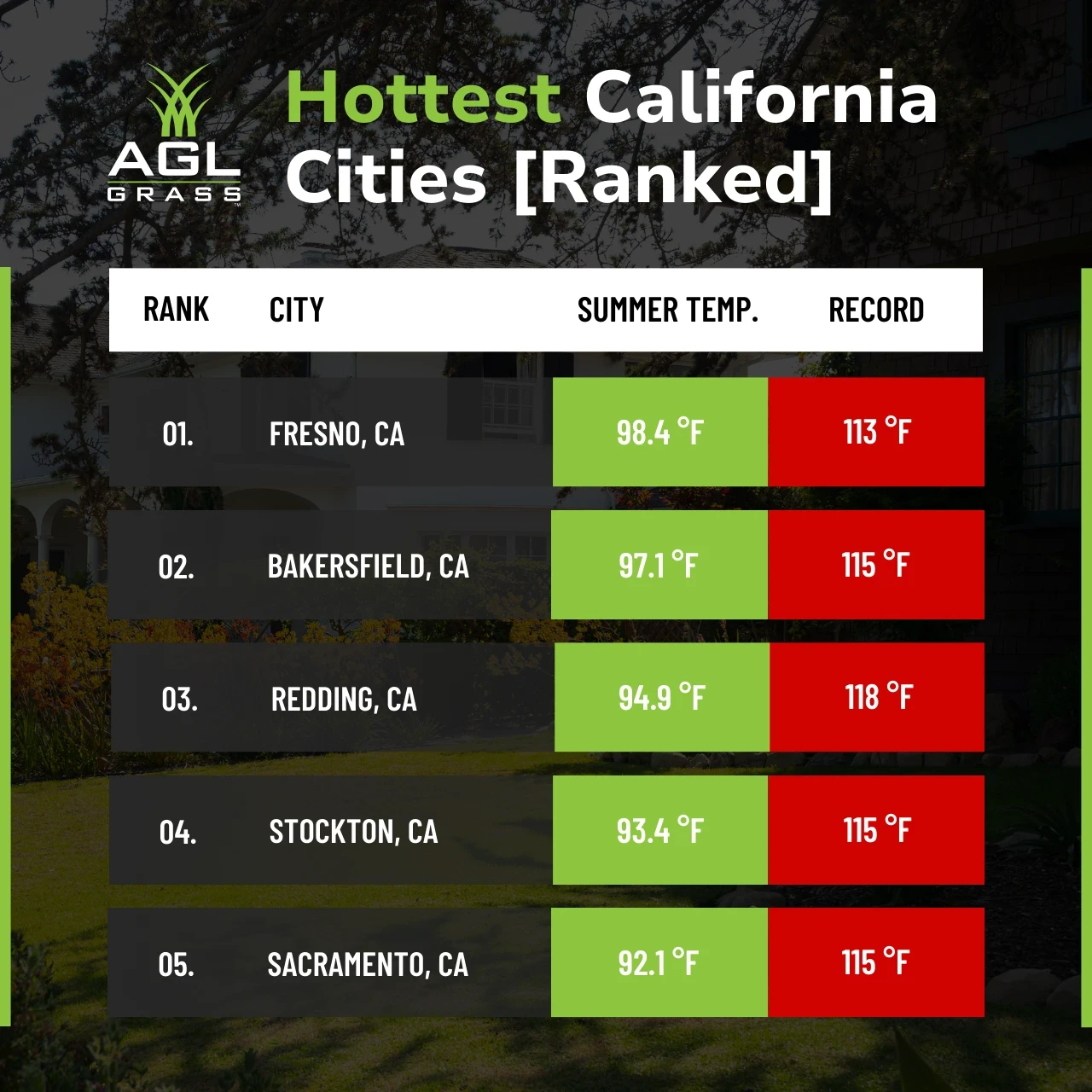
Hottest California Cities, Ranked
Sacramento ranks fifth for average summer heat at 92.1°F, but its 115°F record matches Bakersfield and Stockton, so local turf still faces the same extremes as the valley’s hottest cities.
Rank | City | Avg Summer Temp (°F) | Record High (°F) |
|---|---|---|---|
01 | Fresno, CA | 98.4 | 113 |
02 | Bakersfield, CA | 97.1 | 115 |
03 | Redding, CA | 94.9 | 118 |
04 | Stockton, CA | 93.4 | 115 |
05 | Sacramento, CA | 92.1 | 115 |
A Quick Rinse
One of the simplest and quickest ways to cool down artificial turf so you can step on it is to rinse it with a garden hose. A mist on top can cool the turf temperature by 20 to 30 degrees Fahrenheit, which is typically enough to transform a too-hot zone into a space that is safe and functional for kids, pets, or a fast fitness session.
This comes in handy on days when the air itself feels heavy, as you still want to make use of the yard, even for a limited time. In Sacramento, the strongest sun tends to hit during peak in the mid to late afternoon, when the harsh UV that browns natural grass and inferior turf is most destructive.
One easy habit is to rinse your turf in the late morning if you anticipate a midday gathering, or 20 minutes before an evening barbecue or play. A rinse before the sun is blazing reduces heat absorption, and a rinse after a long, hot day resets the surface.
AGL Grass North's no-infill systems drain freely, so water doesn't pool or linger. The fibers and backing drain quickly so that you can hose the turf down and it will stay playable, not soggy.
This blend of smarter design and basic irrigation provides a more enjoyable surface without turning on the sprinklers like a natural lawn would have to during an extended Sacramento heat wave.
Shade Sails
Shade reduces surface temperatures more than nearly any other measure, which is crucial in Sacramento, where extended periods above 100°F can make open, unprotected synthetic lawns difficult to use. Shade sails or awnings over high-use areas, like a kids’ play zone, a dog run, or a seating corner, block direct sun, protect against UV, and help keep the artificial lawn from reaching that blistering-hot temperature that sends everyone back inside.
For enduring performance, fabrics must be UV‑resistant and rated for high‑sun climates. Here, that translates to fabrics that resist months of fierce sun without disintegrating or fading, as opposed to cheap covers that droop or discolor in a hurry.
Several homeowners combine massive shade sails with movable deck umbrellas so they can move shade over lounge chairs, a kiddie pool, or an outdoor dining set as the sun shifts. Shade structures maintain both aesthetics and comfort.
Sacramento’s fierce summer sun can quickly bleach out natural grass and low-end turf, but superior shading, combined with higher-quality synthetic grass products, helps maintain color more evenly. AGL Grass North can design turf plans with integrated shade zones, so your primary gathering spaces stay cooler and more lush, rather than roasting in full sun all day.
Smart Timing
When you want a cooler yard, timing counts as much as tools. In Sacramento, outdoor time on turf is generally best in the early morning and late evening, when air temperatures cool and the surface begins to radiate heat. Most of us already move walks and workouts to earlier or later.
The same reasoning applies to kids’ playtime, backyard games, or turf entertainment. During the prime afternoon window, say 2 PM to 5 PM. On 100+ degree days, it might be wise to restrict long turf use altogether.
On certain days, it’s just too hot outside, which is why savvy homeowners mix their turf with a few other tricks, like shade trees, portable umbrellas, and perfectly tuned indoor air conditioning. Phone reminders or smart timers on hose bibs can help you rinse turf at key moments, like right before guests arrive or before the hottest part of the day.
New turf systems with cooling infill, which can keep surfaces approximately 30°F cooler than their predecessors, perform best when combined with this type of intelligent scheduling. A lot of Sacramento homeowners are leaving high-maintenance grass behind for low-water turf, and they’re seeing the best returns when they combine cooling tech with realistic usage patterns.
AGL Grass North assists in charting those patterns, allowing your synthetic turf to remain playable for more hours, not just during the occasional mild day, but throughout the extended, scorching spans that characterize a Sacramento summer.
In Conclusion
Sacramento turf does get hot in summer, no question. Midday sun, 100-plus days, and dark, dense turf all conspire to push temps up. Still, that’s not the end of the story.
Smart decisions make an enormous difference. Light turf colors, no-infill constructions, and a bit of shade from trees or a pergola reduce the heat in a real way. Rinses, timing plays for mornings or late-day, and small shade spots for kids and pets also assist.
The question is less ‘does turf get hot?’ and more ‘what kind of turf and setup fits my yard?’ For next steps, chat with a local Sacramento turf pro, request samples, test them in your own sun, and see what tickles your toes.
Frequently Asked Questions
Does artificial grass get too hot to walk on in Sacramento summers?
Yes, it can. On 100-degree Sacramento days, synthetic grass can reach 120 to 160 degrees, particularly in direct sunlight. Premium, no-infill artificial turf options like AGL Grass run cooler. Shade, light-colored turf, and proper installation help maintain more comfortable surface temperatures. Usually.
What makes artificial turf hotter in Sacramento compared to natural grass?
Artificial turf absorbs and retains more heat than natural grass. Factors such as darker blades, rubber infill, and direct afternoon sun, along with nearby hardscaping, can significantly increase surface temperature, making synthetic lawns less effective at cooling than real grass.
Does using no-infill turf keep my lawn cooler?
Usually, yes. No-infill systems eliminate rubber or sand that can hold heat. Many synthetic grass products feature cooling features and breathable backing, which can significantly lower the surface temperature your feet feel during Sacramento’s intense summer sun.
How can I keep my artificial grass cooler during peak Sacramento heat?
Select lighter-colored, sun-reflective synthetic grass options and avoid dark rubber infill. Plant trees or install shade sails or umbrellas for a friendly, low-maintenance landscape. Break up large artificial lawn areas with plants or mulch. On the hottest days, a quick hosing cools pets and kids temporarily.
Is artificial grass safe for pets in Sacramento’s summer heat?
Yes, but with precautions. Synthetic grass can get hot on paws in the afternoon. Shade it, water it, and test the temperature with your hand. Consider artificial turf options, such as cooling infill or an even more eco-friendly, no-infill turf. Be sure to let pets out on the synthetic lawn during cool mornings and evenings.
Will my yard’s layout affect how hot my artificial grass gets?
Absolutely. South, and west-facing yards, full-sun areas, and turf adjacent to concrete or rocks heat up more under the intense summer sun. In contrast, spots shaded by trees or buildings remain cooler. Your yard’s ‘microclimate’ is key when selecting synthetic grass options and planning shade.
What should I look for in a “cool” turf product for Sacramento?
Opt for light-to-medium greens and UV-resistant synthetic grass products, particularly those labeled “cooling,” “heat-reflective,” or “low-heat.” Inquire about artificial turf options with no-infill from AGL Grass North. Give us a call today at: 1 (916) 251-7123.
Read more

What Actually Makes Turf Safe for Dogs: A Placer County Owner’s Guide
Every turf company in Sacramento will tell you their pet turf is safe for dogs. None of them tell you what that means.
Jerry
Owner, AGL Grass North

How to Build a Backyard Putting Green in Placer County
Most backyard putting green guides are penned by companies eager to install one for you. This one is from the folks that stock the turf.
Jerry
Owner, AGL Grass North

Benefits of an AGL Grass Soccer Field
The 2026 FIFA World Cup is putting soccer in front of a new generation of players right here in AGL Grass North's backyard. A no-infill AGL Grass XL Pro Sports Turf field turns that excitement into a place to actually play, today and for years after the final whistle in July.
Jerry
Owner, AGL Grass North
How long does artificial turf last in Northern California?
High-end synthetic lawns like AGL Grass can last 15 to 20 years with proper installation and maintenance, though actual lifespan may vary depending on regional climate conditions. In general, they outlast most natural lawns.
Jerry
Owner, AGL Grass North
AGL Grass North Turf Remnants & Short Rolls
At AGL Grass North, we offer premium turf remnants and short rolls for homeowners, contractors, and DIY builders looking for a budget-friendly way to complete smaller projects. These discounted pieces come from the same no-infill, non-toxic, durable artificial grass our certified installation partners use every day. Just in smaller cuts, sold as-is. If you’re working on a compact space or a quick improvement project, remnants and short rolls are an easy, cost-effective solution.
Jerry
Owner, AGL Grass North
Is Artificial Grass Worth it in Northern California?
Artificial grass allows Sacramento homeowners to reduce water consumption during harsh, dry summers and drought mandates. Check your local water district for rebates to help with the upfront costs.
Jerry
Owner, AGL Grass North
Santa Clara's Possible Infill Toxic Turf Ban: A Greener, Safer Future?
In recent debates over urban planning and public recreation, Santa Clara, California, is considering banning traditional artificial turf that uses toxic infill. The intent behind this possible action demonstrates an increasing apprehension for environmental security and public health. This morning, we'll unpack what this means and why no-infill artificial turf might be the holy grail we've been looking for.
Jerry
Owner, AGL Grass North
The Myth of No-Infill Artificial Grass
In this article, we will cover three myths surrounding synthetic turf and the supposed need for infill. Don't believe the hype.
Jerry
Owner, AGL Grass North
Transform Your Outdoor Space with Best-In-Class Artificial Grass
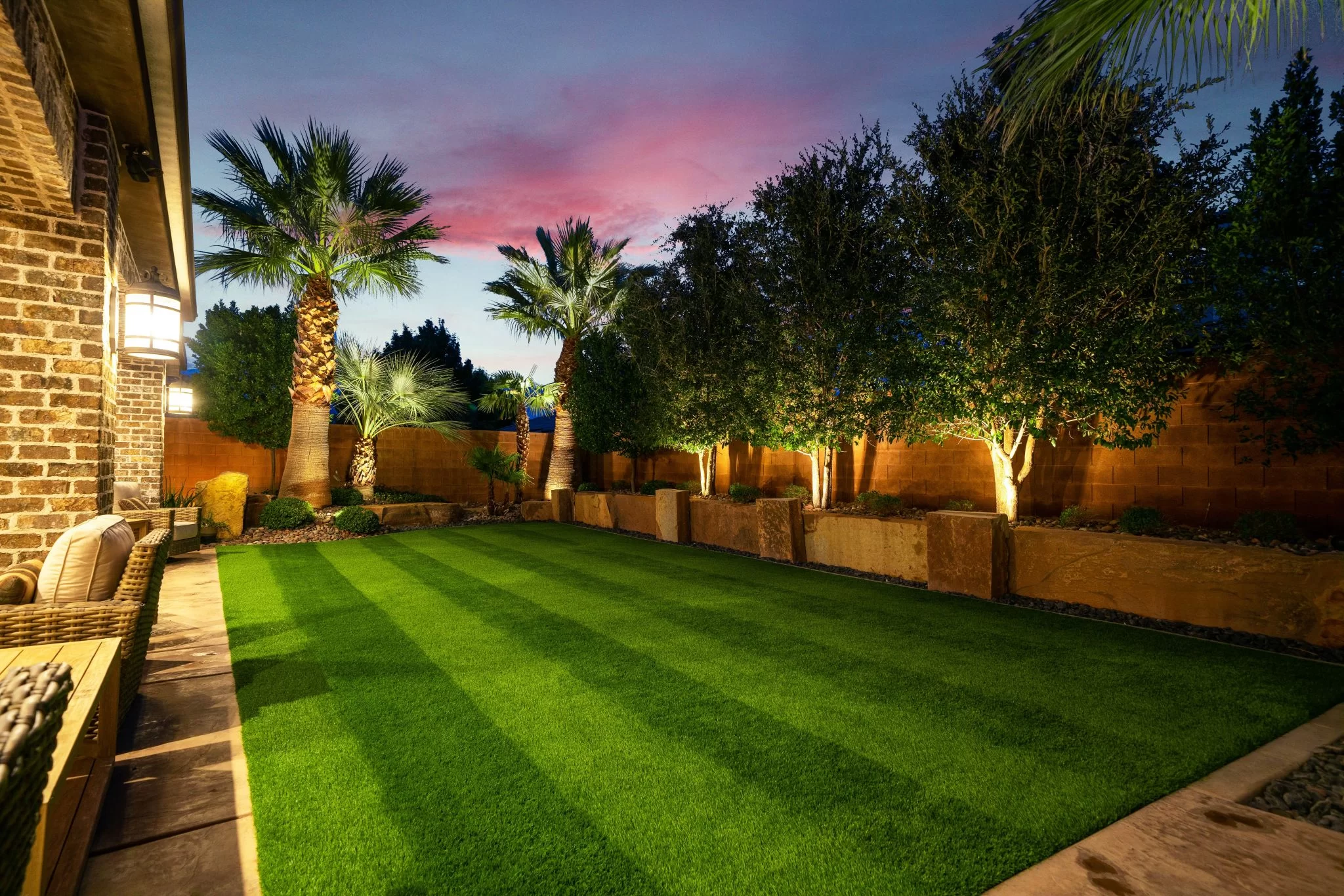
Most guides on artificial grass are written by companies that want to sell you an installed yard, which shapes what they tell you. This one is written by the people who stock the turf. Our showroom sits at 4445 Granite Drive in Rocklin, serving Greater Sacramento, Placer County, the Bay Area, the Central Valley, Reno, and the Pacific Northwest, with nationwide shipping beyond that. What follows is what actually differs between products, what Northern California does to a lawn, and where to go next depending on what you are building.
Jerry
Owner, AGL Grass North